The Dutch indifference to bikes (and why that’s good)

My family visitied Amsterdam on vacation this summer and I expected to glory in the bicycle-centered utopia that I'd read about. I\'m a bike guy. I built my own bike, read about bike parts, and pay attention to bike journalists. I can tell you the factory in Taiwan in which my bike frame was produced. I recognize focussing on an object as a hobby is a bit odd, but I'm ok with that.

Most other bike guys I know laud Amsterdam as a bike-centric utopia. Yet, in my short time there (4 days) I did not find a bike-crazy community.

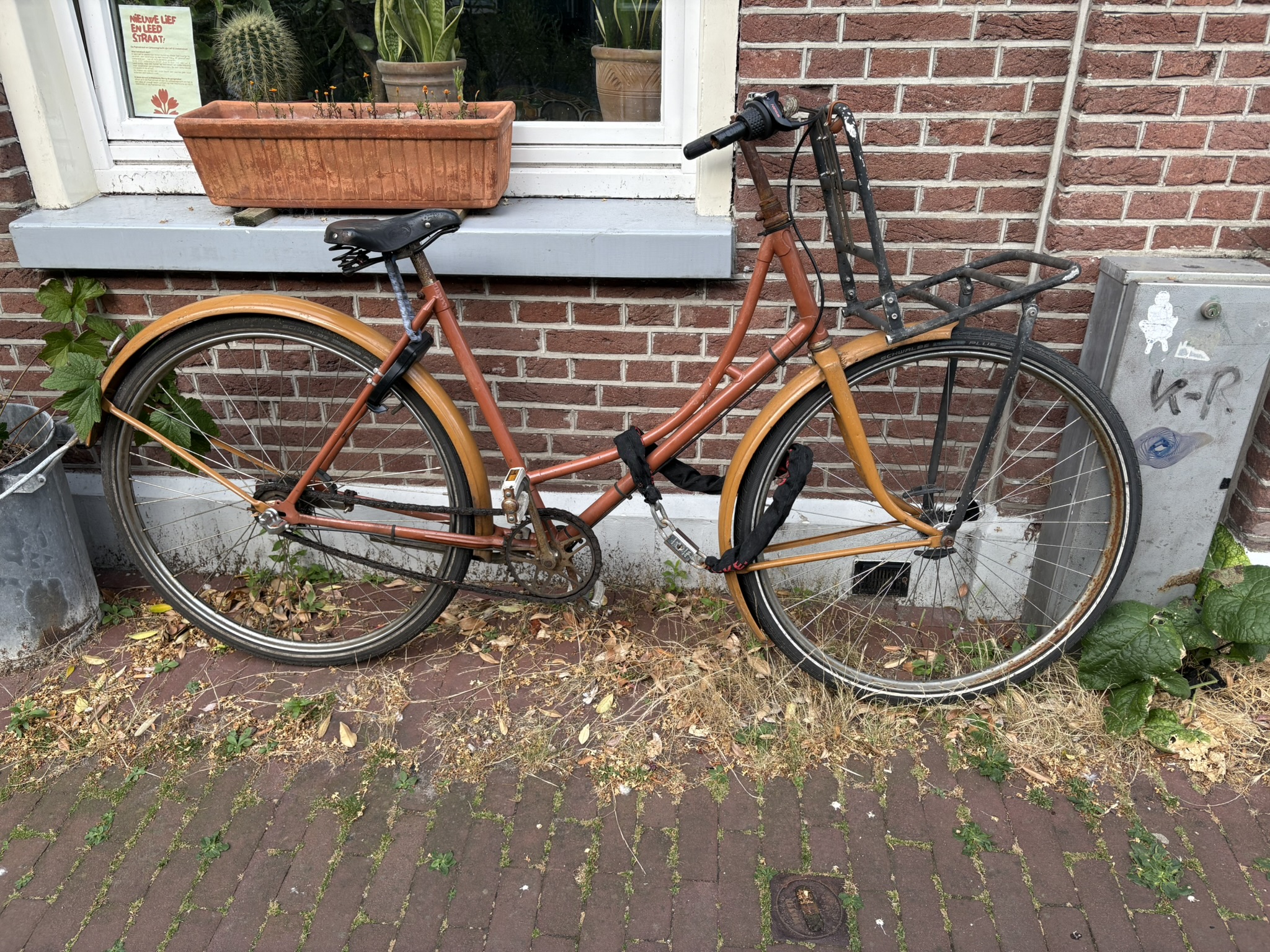
In contrast, the Dutch I talked to or witnessed didn't care much about bikes at all. The majority of the bikes I saw were not facncy, or well-cared for, often the bikes were all-but-ignored except when ridden. Here's a Dutch Omafiets with a sagging, rusty chain and yet is lock with a heavy chain lock and saddle lock! Image

I rode a similar but better maintained bike through a large park for an hour, the bike is called an Omafiets or grandma bike, and it was a terrible riding experience, slow, hard to steer, and heavy. Where was the bike nirvana I saw on Youtube! The Dutch seemed indifferent to the bikes in their midst, even as they rode around the best bike network in the world.

Amsterdam has removed 10,000 car parking spots in the city and plans to remove another 10,000. Bike repair or rental shops outnumber car repair or rental shops in Amsterdam. And everyone, from 2 year olds perched in car seats to grandparents heading to the grocery store seems to bike. Are there cars? Sure, but, cars don't dominate the city.

With so many people who bike everyday, how come I witnessed so little interest in actual bikes as the mechanically wonderful objects they are? At least part of my attempt to answer this question is to pay attention to analogous situations in my life. In my neighborhood, most families have two cars. Rarely do we talk about who made the cars, what the parts are, what parts we might like to swap or improve. The automobiles just exists, and most residents only care for what the car can do, which seems at least partly what's going on with the Dutch. The Dutch don't love bikes, but they love what bikes do, which is get people around a city easily, efficiently, and with no polution.

I've been thinking about this contrast, a city that privileges biking with a populace who are indifferent to their bikes as I consider my current digital humanities tools in my classes. I've often tried to convince students of how cool the tool is -- look at this GIS map of the ancient world! -- and received an unethusiastic reception. What I'm contemplating, is how to build systems that improve students' learning that highlight what they can do with the resources I'm sharing.

In the past I've adopted a philosophy for my teaching known as capability theory, advocated and developed by Amartya Sen and Martha Nusbaum. Capability theory argues resources should be allocated not based on utility (such as the greatest good to the greatest number) or rights, but based on what allocation of resources expands peoples capacities. So, giving women the right to education does little unless a society also provides women with resources to ensure their safety and life, such as housing , healthcare, and transportation. Put another way, resources should be allocated based on what the resources help people do. Expanding access or rights is fine but enablign action is the goal. So, people who bike and walk have the right to occupy most Dutch city streets and cars are guests and must yield to humans. What this right enables, however, is the capacity to move safely through the city for all ages.

In Amsterdam, the entire transportation network enables people to move across the city without cars. And this transportation network includes bikes, but the bikes aren't the point. The quality of life is the point. If I substitute "quality of life" for "learning" I think about how my assignment networks support (or don't) students. How am I building their capabilities to learn, not just focus on a single tool?

Reflections on my sabbatical

I undertook sabbatical projects during the 2024-2025 school year. My purpose was to complete three courses in project management, study data visualization using the books R for Data Visualization and produce five visualizations from my self-study that correspond with sections 1-5 of that book, and produce teaching modules for the Fresh Water Studies project that include assignments, sources, and a template for other faculty to use.

You can find the module I produced at freshwaterstudies.org

During my sabbatical leave I passed three courses at Metropolitan State University - DSCI 620 Project Management, DSCI 630 Risk in Project Management, and DSCI Leadership in Project Management at Metropolitan State University.

Applying some of my newly-acquired knowledge from the project management program, I have created five new teaching modules that are semester-long projects for students to write research reports. Students will create reports to support the creation of a new historical video game, a historical novel, a disaster preparedness team, or a new clothing and shoe brand. A fifth group will learn about project management to support the four other groups. All students will read a core group of historical texts and learn key digital humanities skills. Students will produce their weekly assignments -- based on history readings and digital humanities tools – as the stepping stones in their semester-long project to produce a research report based on their case study topics.

In addition to the five semester-long modules I produced, I also created two other teaching modules, one a single-day in-person lesson on understanding river conflicts in the Indus River region, and another, that uses the Reddit form of an AMA (ask me anything) session as a public history outreach for timely events.

I produced five graphs from my self-study of the book R for Data Science: Import, Tidy, Transform, Visualize, and Model Data. The five graphs represent data visualization skills covered in five sections of the text: “Whole Game,” “Visualize,” “Transform,” “Import,” and “Program.”I used data with a variety of permissions, some of which was student data I collected and did not collect permission to publish from the students, so the graphs are ommitted from this blog but were submitted with my sabbatical report along with the Rcode for the report.

Activities of Sabbatical that helped Accomplish the Objectives

The courses at MetroState were asynchronous, so I worked on my own or with group partners to complete projects for the Project Management and Project Risk Management Course. The Leadership in Project management course was a self-study course using a Project Managment Professional Exam study book and several Harvard Business School case study modules. For the Leadership course I took the quizzes at the end of each chapter multiple times, and recorded my answers. For the the Project Management and Project Risk Management courses I took notes on all the chapters we read, and then applied my learning to projects assigned by the professor. For the Leadership course, I took notes on the chapters in the review book and then used my notes to take the quizzes and exams.

Producing the teaching modules required sustained reading across many disciplines to find materials related to water history. The public bibliography generated from this reading now has 123 entries, up from around 60 when I began my sabbatical. Attending a virtual conference, Conference to Restore Humanity, helped me think about how to rework my classes around semester-long projects that allow for more revision of assignments. In the past, I dropped the lowest assignments, but that practice does not encourage continuous improvement as strongly as revisions does. As well, the conference helped me understand the limits of open teaching on the web. As a result, I am putting more of my reading and assignments behind a simple password for my students, so they and I can focus on learning and teaching, shielded from potential political haymaking or Ai scrapers.

Two of the modules resulted from impromptu ideas. The lesson on the Indus River valley resulted from an invitation to guest lecture in Celeste Tường Vy Sharpe’s class. The Reddit AMA modules emerged from my desire to try a different type of public history that is just in time and low stakes learning for Normandale students. All the teaching modules resulted from typical scholarly inquiry, including researching new sources, reading and taking notes on those sources, and the distilling the elements of those sources that would serve student learning into coherent assignments.

Learning data visualization involved taking notes on the R for Data Science text, and answering sample questions. More usefully, I attempted to pull data from the State of Minnesota's river databases, population data, MinnState employee pay data, student-generate data from surveys, and my own data. Using raw data that needed cleaning and reformatting required innumerous StackExchange inquiries. I learned that common questions on data reformulation result in wrong answers that are now being repopulate on the Ai produced web. For example, one questions about reformatting I had resulted in five websites that all repeated some version of “if you turn / into a \ , the code will work. After learning to avoid certain websites in favor or better moderated ones, I realized the incorrect source of this advice, and how it was was scrapped and then redeployed by click-farm type website. The project management courses took the most time of my sabbatical, but looking up answers to coding issues was likely the second most time-consuming activity of sabbatical.

The following are lessons I will apply to my teaching resulting from my sabbatical work:

  1. Project management is a valuable skill and the rudiments of the field are skills history students need.

    Project management is practiced in so many different fields, including history, that I feel compelled to include a bit of it in my courses. One of the challenges students often face is outlining a big task, say a semester-long research paper, and then following steps to complete that ask. My goal is to increase student success by better equiping students with project management ideas, which will aid them in coursework and beyond college.

  2. Data finding, cleaning, and organizing is more than 75% of the work in data science and I should prepare students better for this reality when it comes to historical statistics.

  3. After studying R for some years, I've concluded the language is not useful for undergraduate history students: it is just too complicated. That said, from my study, I have learned that finding and transforming data, in spreadsheet or database forms, remains a valuable skill. Yet, I often give my students simple data sets, say per capita GDP, that ask them only to interpret the data. From my study of R, I realize I need to design better assignments that mimic the wrangling part of historical data science, not just the interpretation.

  4. Centering student learning requires I offer more learning options, even though that may mean less deep attention to single topics in history.

    As I wrestled with the emerging problems from Gen Ai usage by students, and I realized that projects offer a way for students to do iterative work, that is low stakes, and yet attends to the skill development as historians and as future employees. Having abandoned high-stakes testing a decade ago, my preference is for bite-sized formative assessments of learning. Gen Ai complicates that type of bite-sized assessment model. Asking a weighty historical question “What sources and historical details should be included in a history simulation game focused on rivers” I hope eliminates the usefulness of Gen Ai, while engaging student’s curiosity. I originally considered offering only a couple case studies, a historical novel and historical video game. Reviewing data from my survey’s indicated that many of my students were business majors, and many “want to make a difference” so including a disaster recovery and brand building case study will hopefully help me meet those students where they are.

Final Thoughts

Most of my sabbatical projects were unfullfilling, and though ultimately useful to my students, were soul-wearing to complete. I wish I had been braver to fight to pursue more dynamic and interesting historical projects, but at the time I submitted my proposal I did not have the time or patience to argue for why the historical discipline needs innovative teaching projects.

I did create one project on my own that relates memory, death, and food. I call it "Extending the Story" and it takes the form of a recipe sheet you give to someone you know who has lost someone to suddent death. The bereaved shares a recipe the deceased enjoyed, along with a memory of that person, extending the influence of the deceased even though thev have passed. Given more time, I'd investigate the rich history of recipe books as historical memory and mechanism for dealing with grief.

A second project I considered is finding professionals with history degrees, interviewing and photographing them, and then producing foamboard posters that read "I am a history major." There are numerous famous history majors - Steve Carell, W.E.B DuBois, Carly Fiorina, Martha Stewart, Sonya Sotomayor, Lauren Hill, Cory Booker - (I have slideshow) but I want my students to see success in everday people. For example MPR journalist Cat Richert was a history major.

Sometimes the best projects are the ones that are done.
Open teaching, Ai, and amphetamines.

As I contemplate returning to teaching after sabbatical, I'm pondering some pedagogical choices, big and small.

Should I continue teaching on the open web? For a decade, I've put all my materials on my own self-hosted site. Students can access materials faster, my high-school concurrent enrollment students can share with parents easily, and former students can access syllabi for transferring to other colleges without asking me. Other educators can also access my materials, which are creative commons' licensed.

That said, corporations used my materials to train Ai software that damages the environment. As well, we face galloping fascism today, and I teach world history, which covers peoples that fascists do not want covered. So, I'm going to start password-protecting certain materials, such as assignments. Considering what to protect and what to keep open requires some thought.

My second question, unanswered right now, is how to structure courses given the rampant Gen Ai usage? My short answer is to build supportive learning environments that reduce harm, encourage academic integrity, and help students hold each other accountable. I've been considering how similar Gen Ai usage is to amphetamine use, and thus far the analogy holds well. Both can be useful in small doses in controlled environments, but their large scale use has disastrous consequences for users and our world. From news reports and colleagues I've learned that more than 80% of students have used Gen Ai for homework. So, treating the who class as recovering addicts seems appropriate, odd as that is to write.

I'll likely write more about the drug/Ai analogy.

The Gloria: An Open Teaching and Learning Award

Originally published 2015/02/20

Every day, in every college, students, faculty, and staff struggle. Those struggles can be epic (how do we cure cancer) or limited (how do I factor this polynomial, how can I help this student right in front of me). Lots of folks struggle. When movie makers struggle and succeed, they get awards. Big thinkers get awards named after famous people (Nobel, MacArthur). Even people in college get awards- employee service awards, student scholarships, honor societies. Yet most awards focus more on the epic side of struggle: big events that are marked with degrees or money or wide acclaim. And those awards are given by big institutions.

We need an award for the everyday struggles and successes in teaching and learning, less epic, and more open to all. Not an award for participation, attendance, or mere competence, but for meaningful struggle to make college better. I give you The Gloria.

The Gloria is an open teaching and learning award. It can be awarded by anyone at the college to anyone at the college. The Gloria carries only the payment of a grateful giver. You can give as many or as few Glorias as you wish. You can alter The Gloria however you want (it's open, like open source programs: I made it, you can modify it). The Gloria can be given to a student from a professor, to a professor from a student, to a staff member from a professor, to staffer from a student. . . you get the idea. A few examples.

The Gloria for

  • "Struggling with the registration system to get me the class I need to graduate" goes to Alice, who works in Records. Presented by Joe Bear, student.
  • "Hauling my butt through a rough month of English composition to help me earn a C on my argument paper" goes to Joan, who teaches in the English department. Presented by Fatima Hassan, student.
  • "Finding a way to care for your kids and still get this homework done the week your mom went in the hospital" goes to Maria Alonso, student. Presented by Professor Fuddy Duddy.
  • "Helping me find a book that proved invaluable to my paper" goes to, Lacey, that reference librarian. Presented by Chuck, student.
  • "Finally mastering a concept you've struggled with all semester" goes to Pat, student. Presented by Professor Fuddy Duddy.

This is an award by you to anyone who has helped make college better for you.

To award you own Gloria, download a pdf or open document version of the award. Fill in the "The Gloria for," "Goes to" and "Presented by" fields and print or email to the recipient. Be creative.

The Gloria is named after Gloria Aronson, emeritus professor of history who taught at Normandale Community College for more than 40 years. She pioneered teaching world history, women's history, and study abroad at Normandale. She'll hate that I've named an award for her.  Even worse, I'm giving her the first award.

Gloria received the first award with the humility and grace that defined her teaching. She thinks this award a lovely idea. College is a struggle- Let's honor those hurly-burly teaching and learning struggles that end in a win with an award- The Gloria.

2025/05/12/ Gloria passed away on April 17, 2025. Her legacy of teaching, caring, and service lives in those who knew her.

The 1936 and 2028 Olympics

I've been thinking about the 1936 Berlin Olympics as we approach the 2028 Los Angeles Olympics. In '36, Hitler wanted to use the games to demonstrate the superiority of the what he called the "Aryan Race" Note: 20th century Germans were neither Aryan (from Persia) nor a race, but fascism hates facts. Hitler barred Jews from competing for Germany, although at least one athlete with a Jewish father, Helene Mayer, did participate. Leading up to the games, Joseph Goebbels hid some elements of antisemitism from public display, for example ordering anti-Jewish signs removed in Berlin. There were significant disputes within nations about whether to field Jewish athletes, and the US famously benched two 4 x 100 Jewish athletes, [Marty Glickman and Sam Stoller.] (https://www.ushmm.org/exhibition/olympics/?content=jewish_athletes_more)

Following the Olympics, Hitler began World War II and carried out what we now call The Holocaust.

In February of this year, President Trump claimed to exclude transgender athletes from the Olympics. He repeated a lie that two women boxers in the Paris Olympics were transgender (they are not) and Trump demanded the International Olympic Committee conform to his wishes.

Trans-athletes, like Jewish athletes of the 1930s, and most all athletes, are not Olympic caliber athletes. Targeting these groups is about an assertion of power, not about fairness. In the 1930s, many people, not just Nazis, supported excluding Jews, as witnessed later when the US turned boats of Jewish refugees away from US ports. (3) Just as today, many in the US, like California Governor Gavin Newsome, are willing to agree with Trump in his targeting of Americans athletes who are trans.

The 1936 Olympics gave Hitler a huge stage for his Nazi ideology. I wonder what the 2028 Olympic Games will highlight, especially given the desire of billionaires (who sponsor the games through their corporations) to seek favor from the President? Given the swelling patriotism of people in Canada, Panama, and Greenland (have your heard the boos at sporting events with US teams?), I'm not sure what to expect. Russia held the 2014 Winter Olympics, and few athletes or nations declined to go based on politics. Qatar used slave labor to construct it's stadiums, and that didn't keep people from attending or watching. It may be that the appetite for sport is just much greater than the appetite for human rights.

I rarely do cross-chronology comparisons in my classes as I want my students to understand historical events in situ, without imposing modern parallels. That said, the comparison between 1936 and 2028 keep popping up for me.

What I learned from project management classes.

For part of my sabbatical project, I'm taking three project management courses through Metropoitan State University in St. Paul. Much of project management involves making lists. You make lists of risks to a project, lists of requirements for a project, list of resources, and stakeholders, and budget, and scope. Project management attempts to render projects into a recipes, that if followed, will yield successful projects that meet the expectations of clients. This knowledge will be useful to me as I help manage a teaching project on food, floods, and rivers, and to help manager internal college projects, such as committees.

That said, in February 2025, I'm struggling to think about how I could talk to students about project management, or any other topic that relies on evidence-based thinking. Part of what I'm selling as a teacher is "learn this information, it will help you make better choices towards a better life for you and those your care about."

But all this is based on living in a reality where actions and knowledge have consequences. One of many problems with the fascism we are experiencing today is that it over-rides all other values, including democracy, capitalism, religious faith, community, or science. While I'm concerned about the illegal financial cuts to institutions, I'm as worried about the crisis-of-faith fascism encourages. If the only thing that matters is power, then people will respond to that reality. Why study project management, if the only factor in business is if the fascist leader likes you?

All the project management training, or any training in the world, won't help if the fascist elites commander the wealth of Americans for themselves. At one point, if ever do actual conservatives (not fascists, but those who want to conserve previous generation values of faith, democracy, science) say no? And how do I teach historical thinking to students who are witnessing the death of their future?

Other education theorists who lived through encroaching and galloping fascism have considered this idea, I'm sure. But I teach this fall, so I'm wrestling with it now.

Biking in winter in Minnesota: lessons for education.

Concern for my children and global climate change spurred me to start biking to work this year, after a long layoff. My trip takes me from Minneapolis, through three suburbs to my college in Bloomington, about 9 miles one way. Scheduling constraints and the limits of my middle-aged body translate to 1-3 bike trips a week. I stopped riding for six weeks from December to January when below-zero temperatures or consistent heavy snowfall made biking unsafe.

As I ride I think about my teaching and my students' learning. What follow are some of my thoughts on the parallels between higher education and commuting by bike, though others likely have stated the same with greater skill. I'll leave it to your skilled mind to substitute the education parallels.

For most of my ride, I control very little except my choice of path. I don't get to choose where roads were built, or how safe the existing bike infrastructure is, or the outside temperature or precipitation. Good preparation, in clothing, bike accessories, and knowledge of my desired route, is the primary way I can ensure a safe and comfortable ride. Minor mistakes in planning, forgetting a towel or underwear, can significantly disrupt the rest of my day.

Every motor vehicle I pass is an existential threat, so I defer to everyone. "Hey bike boy, go #@$! yourself!" - "Ok, have a nice day" I reply. It's useless to get angry with the roads, or the weather, or even bad drivers: there's no remedy. Patience and forward movement are the only options, especially with slippery conditions. Just keep going.

Biking requires constant effort and attention, and with both I arrive much faster at my destination. Poorly designed infrastructure, like traffic lights that need a car's weight to trigger the signal, force me to make difficult decisions. Should I cross against the light, or wait through several cycles until a car pulls up next to me to trigger the light? My choices are often made in less-than-ideal situations, yet as long as I get home safe, I judge my choice a good one.

Commuting to work highlights race and class issues. My bike lights and shiny jacket tell drivers I'm not poor. I can afford bike parts and accessories that make biking comfortable in most weather situations. Many people express admiration for rich people biking to work, which is odd as I see many low-income people biking and wonder if their co-workers admire them for this everyday activity. As I bike through predominantly white neighborhoods, no one has stopped me to ask me what I'm doing there.

Arriving at work or home feels a little epic, and I wish (just a little) that people acknowledged that minor epic quality that commuting under human power entails. "I'm here and it was not easy arriving: a little love?" People that acknowledge the epic quality of my day, "how was the ride?" make me feel more welcome and valued in their presence.

Moving through a community in a way most people don't move inspires deep humility and vanity. Listening to the humility offers wisdom.

When do we just abandon the road?

I recently saw the mock-ups of my college's new website: it's terrible. It emotes a fascist and fetishistic adherence to a white/black/red color scheme, includes lots of shouty titles in ALL CAPS and deploys a cramped font that even at normal reading distance and size is hard to read. My friend pointed out these issues, and I agree with him, and am taking his critique one step further. As digital infrastructure, it's a new strip mall, reflective of 2021 digital architectural values that somehow ignores humane design cues. The smiling student pictures (always in boxes) can't penetrate the modernism. Horkheimer and Adorno would giggle and then weep. The new site isn't all bad: finding material should be easier, but it's not going to be pleasant or welcoming.

Reviewing the new site made me think about how we have different and lower expectations for digital infrastructure than for physical infrastructure. Our content management tools are a great example. We try to "manage" learning with CMS that are like the worst Old Country Buffet ever: endless choices laid out in confusing groups, like hot mac and cheese next to jello which is perched on bbq ribs, all of which sit behind curtains that only open when you tickle them with feathers. What, you didn't click on the tiny down-arrow carrot coquetishly hiding behind the ALL CAPS section title?, shame, no syllabus for you!

And this is just the digital infrastructure of the college. The wider digital world has so many more failures, including privacy invasion, the ballooning mis and disinformation worlds of social media, racist and opaque search algorithims, and the failure to treat internet access as a utility, rather than a service. So many households (urban, suburban, and rural) lack access to reliable high-speed internet, it's hard to complain about poorly made internet when so many lack access to it. Even when one was has access to the internet, searching for accurate information is incredibly challenging and that's not just because there's more information available. We largely see what people who pay for search engine optimization want us to see.

The internet can be a place of discovery, support, and learning, but most of our digital infrastructure actively discourages that. As I contemplate redoing my world history 1 course for the spring semester, I'm wondering, when do I just give up on some infrastructure? If I rode my bike on a road that consistantly resulted in flat tires, when would I just try another road?

Some of my favorite authors are black women fantasy authors, such as Octovia Butler and N.K. Jemison. Their protangonists always understand the connections between social systems of oppression and the built world. To succeed, the protagonists always leave the road to find a new path.

Running shoes are broken (a side-note on higher education issues)

The following rant is about how an industry designed to supply one thing (running shoes) can foster inequality amongst the practitioners (runners). I find many parallels in higher education, especially with practitioners of bespoke pedagogies that work only for fewer than 45 total students a semester and education technology companies that sell expensive software of marginal use to students.

There is a running boom in the U.S., the result of closed gyms and stir-crazy athletes in need of a fix. At the same time, running shoe companies are in an arms race to produce the fastest marathon shoes. These expensive shoes are like race cars: they are designed for elites and regular users can hurt themselves if used inappropriately.

With new technologies to tout, shoe companies are increasing their prices. The MSRP price of the big-tent shoe for most companies (the equivalent of a family sedan like the Camry) has increased to $130 from $120. Most of the new elite shoes with claimed high-speed technology sell for more than $180, up to $250, though durability is generally low.

Meanwhile, the move to online shopping has forced independent running shops to spin up websites, quickly. In my city, several local running stores hired the same company to code their websites, with terrible results. Load times are glacial, search features are out of 2001, and the filtering capabilities are. . . odd. They give people the options of "responsive, balanced, or plush" for ride. 30 year of running, and I have no idea what I'd chose for this, and you can only chose one. The site is clearly designed to highlight fashion, not function, as scrolling over the shoes shows you other colors, not specs or an alternate view (say the sole).

As independent running shops are struggling to adjust to their new business reality, the running shoe companies themselves are dumping more shoes online, through their Amazon connections, and pricing the shoes below what the independent shops can afford to offer. I recently found some Mizuno shoes -sold by Mizuno on Amazon- for $70 less than at my local shop. Amazon has terrible labor policies, so I use them as little as possible, but I get why folks make the choice to buy the same shoe for less.

Who do the new technologies and higher prices benefit? Mostly the shoe companies, Amazon, and the very rich and very fast runners. Imagine if someone claimed a new knife would allow you to cook far tastier dinner than before: you'd laugh right? Very few of us are limited by the cutting technology we use in our culinary efforts. It's our time, our abilities, what we're willing to put into an effort that shape our outcomes. The claims that new shoes will make us faster is a lie. If you increased your sleep by 4% a night, you'd have better results than buying new shoes.

Thankfully, there are some countervailing forces. One prominent shoe review site has called out the lie of claims on the Nike Air Zoom Alphafly NEXT% as marketing crap. More shoes sites are regularly listing affordable running shoes, acknowledging that the price-wars to the top haven't yielded shoes that serve most runners. These are positive developments. I doubt we'll see shoe companies to offer their excess stock to independent running shoe companies instead of dumping it on Amazon.

This rant is about running shoes, but we see many of the same trends in higher education. Ed tech, such as TurnItIn and proctoring software, claim to be solving problems, but are really just the equivalent of a price increase for college students. Most of the claimed innovations in digital communication (Zoom, MS Teams) primarily benefit rich students, who can afford fast internet connections on powerful computers. Most students do better with the equivalent of a phone call, perhaps sharing a screen shot at times. Much as with shoes, advances in technology and the structure of the industry are not benefiting most practitioners. Time will tell whether higher ed or runners can push back these trends.

Our Faculty Union Created an Award for Contingent Faculty (and you can too)

Background

My community college has a faculty body of around 40% contingent faculty based on full-time equivalent. Before last year, these contingent faculty weren't eligible for certain awards, including one given by my the state colleges board of trustees, which called their award Educator of the Year. If it sounds odd that you could win and an award for being educator of the year that only tenured faculty are eligible for, well, you're right. But we call the winner of the Super Bowl the world champion.

Contingent faculty are the most hard-working and innovative professors in any higher education system, and they deserve greater recognition.

Process

My local chapter of our faculty union -the Minnesota College Faculty Association - created an award which we called the MSCF Faculty of the Year Award. We didn't call it the Contingent Faculty of the Year Award.

The proposal for the award first went through the executive council of our Union, and then was passed at a full chapter meeting. A committee of five tenured faculty was appointed by the executive committee to adjudicate the award.

First, we called for nominations from the campus. Then we asked nominees if they wished to be candidates. Candidates needed to submit a teaching statement, syllabus, and a favorite assignment. 95% of nominees chose to become candidates. The portfolio the candidates submitted focused on teaching and was intentionally easy to compile, in contrast with many awards portfolios. We encouraged faculty to put "Nominee (or Candidate] for Faculty of the Year" on their CVs.

We asked the campus community to submit statements of support for the candidates.

Our committee reviewed the submitted portfolios based on excellence in teaching, supporting students, and service to Normandale and the wider community. I found that review process to be rewarding as I read innovative and inspiring pedagogy.

The winner was announced at our opening convocation for spring semester 2021 by our Union president and all the candidates received the statements of support made by the community. The winner will receive some academic regalia, likely a medal, to wear at commencement indicating the award.

Lessons Learned

Should you wish to do this for your campus (and you should because contingent faculty members deserve far more recognition than they are given), please consider a few of our lessons learned.

  • Everything will take more time than you think it will, from creating the award process to collecting nominations and supporting statements, to meeting as a committee.
  • The award reflects the values of the campus. Our campus is pedagogy and service oriented; your campus may have a research focus. We included categories to judge the award based on what our contingent faculty contributed to our campus. Note that we didn't ask for a CV, and thus avoided questions of degrees or publications.
  • Getting broad input will improve the award, including from contingent faculty. Our award improved as it went through our executive committee and then chapter meeting for approval, and then again as the awards committee met.
  • Having clear guidelines for how the award will be judged from before you seek nominations will make the award committee's job easier. We had those guidelines, which reduce the potential for the award to be a popularity contest.
  • Someone on the awards committee needs to be competent organizing digital information. We used google forms to solicit nominations and support statements and Office 365 notebooks to solicit candidate portfolios. Meetings were held over zoom after March 2020. This went well for us, but there are many digital bumps that could've derailed the process.
  • Done well, the award process emerges out of an ethics of care and highlights the contributions of contingent faculty and gives those faculty paragraphs of praise for their work.