Running with students.

5:30 am

I'm sitting in a hotel room in St. Charles, IL, just outside Chicago and I'm about to do a hard thing: run a marathon.

This exists to chronicle the challenges of leveling the playing field for poor students in my history courses, so running may seem far afield. Even so, it feels dishonest to not note something so prominent in my life. On runs I craft lessons, puzzle out how to reach students, despair and revel in recent classes, and sometimes just forget I teach and mind the glory of the state of Minnesota.

Perhaps the most important intersection between my running and my students is the strength I draw from them. So many faces challenges far beyond those I've faced, or challenges I faced with 15 years more experience. Running a marathon is not easy, but for many of my students, life is harder. It's harder for the recovering heroin addict who shared his recovery story with me in the fall of 2009 when I came to Normandale. It's harder for the student of mine who works overnight-shifts at a factory so she can send money home to her father in E. Africa. It's harder for my student who is 19 and raising a child alone. Their stories are theirs and I don't wish to co-opt that power, but I will run on it. I run inspired by a decade of students, every one with a story.

I need to run now. I do not run alone.

Safe home.
On incivility in the face of failure (@neatline, @omeka)

I'm trying to use Omeka and Neatline to help my students think about history as something we make, not that we receive. Omeka and the plugin Neatline make hosting online exhibits fairly easy, and hugely easier than coding your own CMS with a GPS interface.

Still, there are things that aren't obvious, especially to a neophyte. There's a bunch of technical rubbish that amounts to one-part niggling user interface quibble and one part shame of the "my students need to learn 21st century skills and I'm failing them" variety that erupted in some Beetle Bailey cursing on twitter today. That was low on my part.

Neatline and Omeka twitter handlers kindly declined to #@$% back, which makes them the better people and better educators.

And I learned a lesson in what some of my students must feel when having reviewed all the documentation I've given them, they still can't get something to work.

Humbling, but I'm going to fail this lesson fast and get back to teaching.

Safe home.

Trying to avoid the LMS sandbox

There's an old joke that when an old man is asked directions by a passing motorist about how to get to the next town, the man answers "you can't get there from here." That story encapsulates my feelings for much software, especially our LMS. Witness my latest efforts:

I'm writing all my posts in Markdown so that I can publish them in multiple formats using Marked. The original txt files then aren't subject to weird formatting errors that happen with MS Word or bad html conversions. As a historian I also like the future-proof element of writing in plain text.

So I wrote up a citations page for the readings for week of my class, exported it as a PDF, and saved the PDF to our LMS. But the LMS likes to open pdf's in its own viewer, and that viewer doesn't always recognize links. Also, the viewer shrinks a full page to 1/3 of the computer screen, which makes reading a document an absurd exercise in magnifying and scrolling. Students can download the pdf, but it's an extra step. I'm looking for one-click usability. So, I switched the file to an HTML file that opens a new tab.

In other efforts, I realized the get-to-know-you quizzes I had in the LMS were cumbersome and wanted something more concise. So I thought, "I can export the quizzes as a CSV file right, and then build a google form?" Nope, I could only export xml, which would've required significant cleanup. For 35 questions, it turns out retyping was faster than actually using the LMS.

Increasingly I'm coming to value the flexibility and usability of tools outside our LMS and am thinking about how to offer these things to my students without turning my classes into an website account-creation hackathon. Single sign-in is important, but how important? If you can't get there from here, why stay here?

Just a few technical details. . . on the imaginary “time off” for teachers.

I'm redesigning my World History 1 course around digital history projects with texts that are free to my students. So that my students have access to the sources I selected five sources from one of our college libraries databases, downloaded those sources as pdfs, stitched the pdfs together using Acrobat Pro, wrote up citations for the sources in Markdown (recall I want to be able to give this course away so documenting everything in a format that others can easily play with is important) and . . .  then, uploaded the sources to a third-party clearinghouse (SIPX) that will ensure our use of the databases clears Title XVII of the U.S. Code on copyrights. That last part requires minor navigation of our college's learning management system so that students don't have to sign in to our library or another website to do their readings.

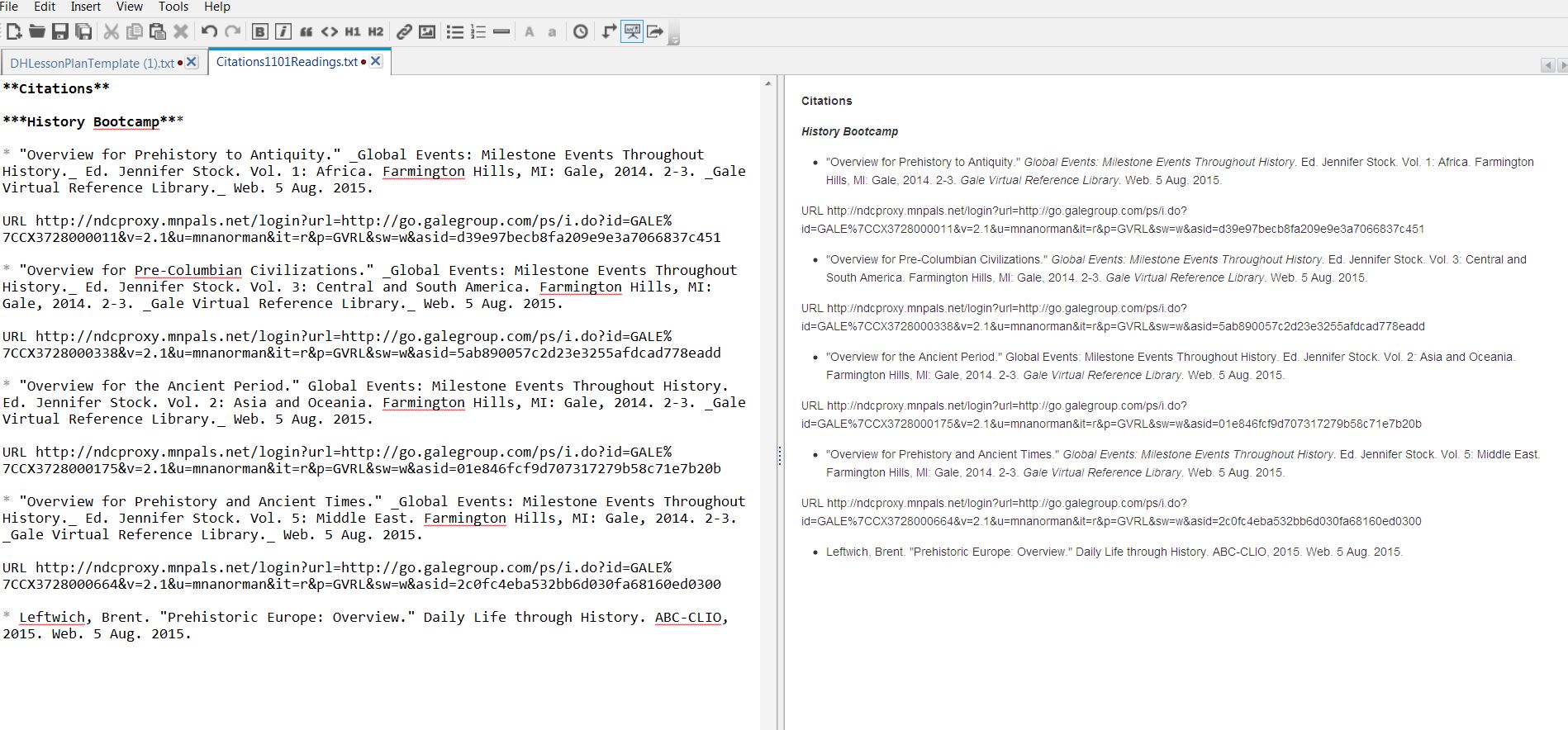
Citations in code.
Citations written in markdown.

Now, if you teach, I'd wager that little in the above paragraph impresses you. You probably do similar electronic jumping jacks all the time. But if you don't teach, please note my activity was for one week's worth of reading. I still need to design the quizzes and the digital history assignments around the readings. I'm on summer "break." This is what we do- a highly-skilled and time-consuming dance that requires time away from face-to-face contact in order to continuously improve our teaching.

So tonight, if one presidential candidate makes a snide comment about educators, I'm going to roll my eyes. Congress may not have its eye on our students' futures, but I do. . . you too I bet.

Safe home.


New format and the absence of values in e-Learning.

To the five people who read this blog: I'm playing with themes. I'll find one that works soon and stick with it.

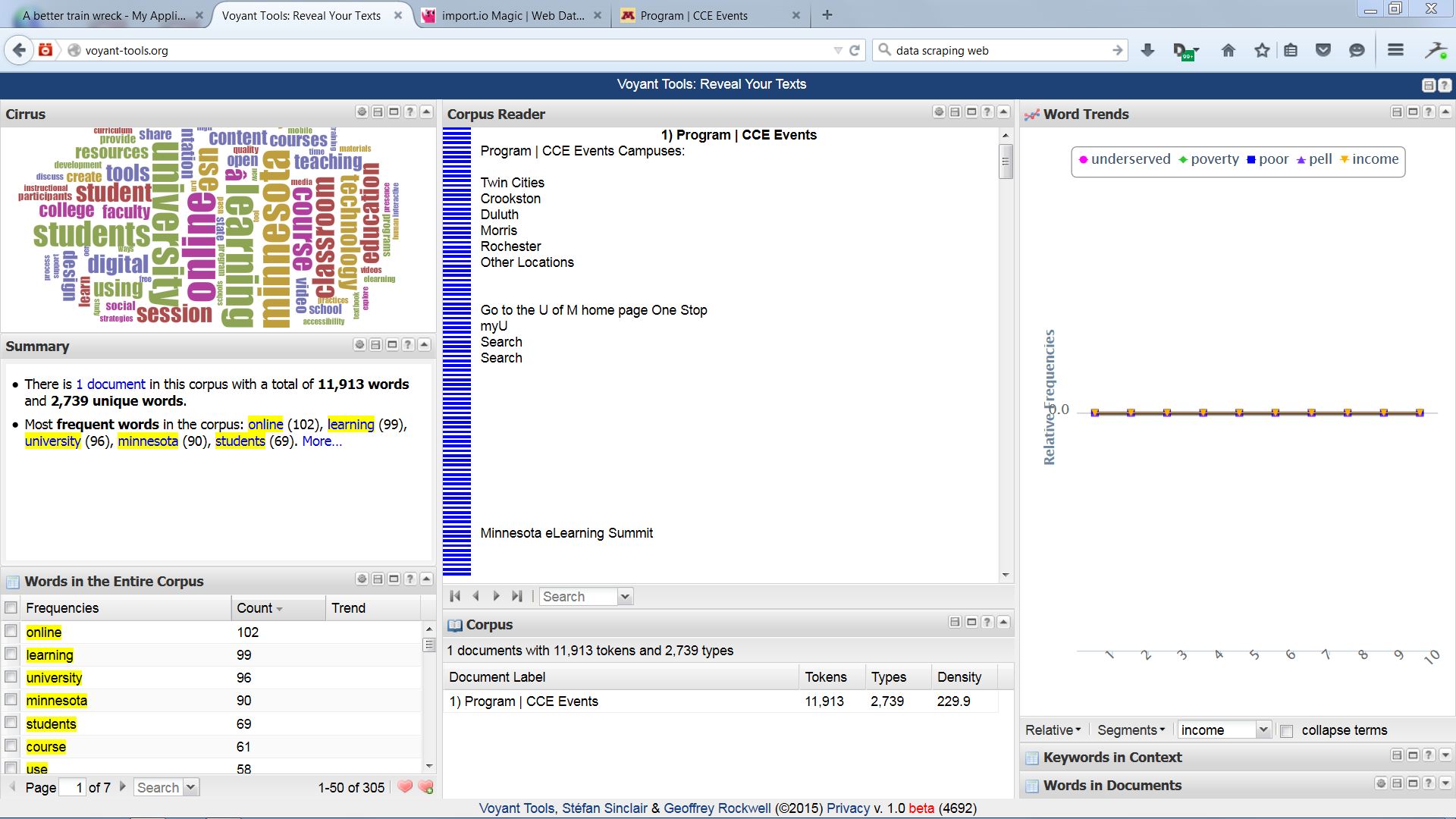
In the mean time, consider the distant reading I did of the entire program of the recent e-Learning conference put on by the University of Minnesota and the Minnesota State Colleges and Universities. I the plugged the text of the entire program in Voyant, and searched for words that address poverty. You can see what I found.

To be fair, there were a couple of presentation about open education resources, but those focused on books, not students.  Next time you attend a conference, scrape the entire program into Voyant and see what it tells you.

Graphic of voyant.
What words were missing from the program of the conference? See the graph on the right of the image for the words I queried.

What is a better train wreck.

When I originally conceived of the title for this blog, I was stealing a phrase used about patients who have myriads of medical problems. Colloquially and away from patients, doctors call these patients train wrecks, everything is wrong. There may be mental, congenital, and emergency health problems confounding a team of physicians working like mad to put out one fire after another. When I asked what do you do when faced with such a disastrous coalition of ailments, how can doctors cope, my wife replied: "you can always make a train wreck better."

I thought the same thinking applied to many of my students. Many students have poor to no family support, medical and mental health problems, food and housing insecurity and full-time jobs. One friend pointed out that calling students train wrecks wasn't terribly respectful even if it was honestly expressed.

I've come to realize that there is a train wreck, but it's not my students. It's the world around them. How is that our country lacks paid time off for parents like every other western democracy? How is it that someone working minimum wage can still not earn a living wage? How can racism continue to shape our lives in such pervasive ways? How do women still only earn a percentage of the wage men earn?

What I find energizing about the train wreck analogy is that it highlights the scope of the problems my students face. I'm realizing that I've been working with a misplaced focus. It's not about making the train wreck that is society a little better, it's about helping students survive the train wreck successfully. Read that again, survive a train wreck successfully. That's mine and every other community college teacher's charge.

Safe home.

Recap of #dhathecc (Digital Humanities at the Community Colleges): Part I

Last week, July 13–17, I attended a National Endowment for the Humanities Institute on Digital Humanities. This post is summarizes my reflections and attempts to point the way forward for my teaching.

You’ll recall my original project had four parts:

  1. Create a course that adhered to an anti-poverty pedagogy course design principles.
  2. Use only texts that were free to students (OER and library databases).
  3. Build the course around digital history tools (that are part of the larger digital humanities–or DH– world).
  4. Package the course and give it away.

I failed slightly less than I succeeded. Still, I believe I can realistically still accomplish this goal, in fact for two world history courses. Part of my confidence derives from my time at last week’s institute (#dhatthecc).

I learned too much for single post so I’ll just list three problems for which I have new options.

Problem: Students have too many DH website that require new logins.

Option: In the first iteration of my DH world 2 course, I had students create Omeka, google, ARC GIS, and a cloud storage accounts. Following an nice intro by @roopikarisam to how to install Omeka on @reclaimhosting serve, I was able to install serval plugins for Omeka. These plugins (versions of Neatline) will let students use Omeka for 5 lesson plans instead of 1, decreasing the mental bandwidth needed to learn a new user interface.

Problem: Assessment of digital projects borrows heavily from face-to-face assessment and lacks a nuanced estimation of DH competence.

Option: An short article in Digital_Humanites titled “Learning Outcomes For The Digital Humanities” helped me think through how to restructure my assessment rubrics in a way that honors the student contributions as DH creators and historical thinkers.

Problem: Students lack agency in what they want to get out of assignments.

Option: Jesse Stommel strongly encouraged participants at #dhatthecc to allow students to self-assess the success of an assignment. I am perhaps less willing to allow students to define all the outcomes for an assignment, yet I do think I’ve been missing an adrogological opportunity to include students in the assessment. I have content, skill, and metacognitive outcomes for my assignments, and @jessifer convinced me I should include a fourth category, something akin to “What do you want to get out of this assignment?” learning outcome on each assignment. Importantly, I think I can ask the students to self-assess and include their self-abasement in the assignment grade.

This is just the first of many thoughts on #dhatthecc . Many more thoughts and thank you to follow.

Safe home.

Is this what middle-age means as an educator?

Is this what middle-age means as an educator?

I'm on the downside of 40, and am increasingly out of sort with the culture in which I live and teach. In areas of life in which I am constant, the world evolves quickly. I've become a 10% guy in a 90% world. I used to wear a men's size medium and now I fit into a small. Everyone but me seems to wear headphones when running. I wear shirts that aren't non-iron.

There's a good bit of privilege in my 10% world, I recognize, but it still feels odd to be so far out-of-sync with parts of U.S. culture. When it comes to teaching, I feel equally out of sync, for very different reasons. As digital humanities scholars race ahead in developing new tools and pedagogies, I'm trying to keep up, translating this newness into digestible lessons for my students. At the same time, I teach at a college that is not racing ahead when it comes to digital pedagogies. There is an openness amongst many professors, yet I am one of the leading instructors on matters digital. So I feel like I'm behind 90% of the digital history teachers nationally but in the the top 10% of teachers on digital issues at my school.

There's a great bit of ink I could spill on privilege, leadership, and cultural equity. I have the time to run, the time or money to press shirts, and access to technology that let's me evaluate where I am as a digital history instructor. That said, understanding where I am situated matters as it shapes my response to changes around me. For general cultural changes, I live and let live. I buy the small shirt and don't try to make that mean anything other than I have a shirt that fits. Yet for teaching, I need to reconcile or at least develop greater mindfulness of how I engage various groups. If I'm in the vanguard, I need to rally friends to follow. "Look I can do it, you can to." If I'm in the rearguard, I need constantly check in with the main host, "what are we doing, where are we going, how are we getting there? And it is a battle we're fighting, against fear, apathy, and ignorance.

Safe home.

I did it. . . again.

I've enjoyed using an Oxford University Press textbook for my World History 1 class these past two years, but I've still so much content that's digital that doesn't fit. Adding digital history lessons to 30-40 page chapters is too much, and I've been exploring the world of Open Education Resources as I teach my World History 2 course. I already abandoned textbooks in my world history 2 course, but now I've done it for world history 1 too.

This will truly be teaching without a net because World 1 goes back to prehistory and includes some of students favorite subjects: the Roman empire, the Mongols, the Mayans. Good thing I'm off to the Eugene, OR this summer for a NEH Summer Institute: I'm going to need all the help I can get crafting a new course. At least I've learned from the pitfalls of my World 2 course. I can't help but wonder what my college's bookstore makes of the $0 next to my courses.

Teaching without a net, again.

Safe home.

Building lessons on free websites . . . or creating children’s books.

One of my favorite "wow" lesson plans uses the website gapminder.com. It presents a variety of data in clear visualizations that let students play with historical statistics. It has huge limitations when studying history. Still, I use it as part of a lesson on quantitative history and the importance visualizing big numbers.

Last week one of the key data sets failed to load (Income per person). The gapminder people corrected the failure in 8 hours, but then the website broke again. Students howled. I howled on the "Report a problem" section of the website. In the end I pushed the due date for their assignment back one day. Nothing ground breaking about the pedagogy or our response to a common problem, yet something worth considering when building from open web resources.

In contrast, for my MN History students, I asked them to write a historical fiction children's book based on 4 chapters in our textbook. One of the learning objectives for the class is to demonstrate the ability to write different genres of history. A full short-story would take too much time, both to teach and to create, but the basics of historical fiction can be taught with children's lit (sources, plot, narrative arc, critical deployment of the suspension of disbelief, historical accuracy). And the final products are just fantastic. Granted, some spend more time on the art than the sourcing, but this low tech assignment forces students to grapple with how to tell a story about the past that even my best digital history assignment don't yet.

So, this week is a contrast in pixels and paper.