Standing Female Deity
Dublin Core
Title
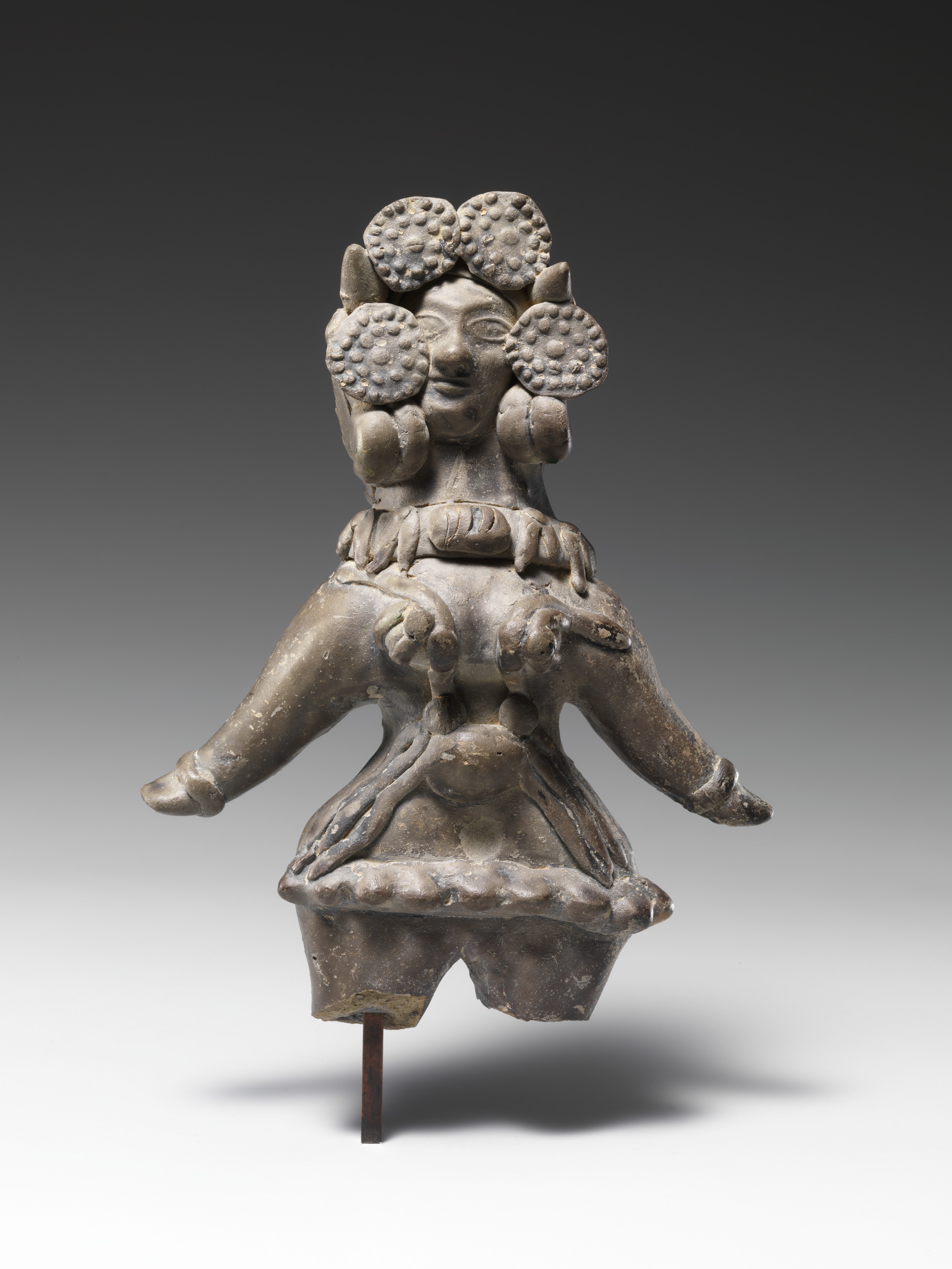
Standing Female Deity
Subject
Sculpture
Description
From the Metropolitan Museum of Art website,
"Date: 3rd-2nd century B.C.
Medium: Terracotta, black oxidation patina
Dimensions :H. 6 1/4 in. (15.9 cm); W. 4 3/4 in. (12.1 cm); D. 1 7/8 in. (14.8 cm)" Sculpture of a standing Deity with a large head piece and necklace.
These sculptures present that early India was very religious and seemed to worship the same Female Deity, possibly Yakashi, throughout. They also show that different materials were used depending on the location and origin of the sculpture. The Standing Female Deity (from Northern India) was created using terracotta and black oxidation patina, whereas the Bust of a Female Deity (Yakashi?) (From India) was constructed with grey clay. I can conclude that the material that was used either showed significance or was the only material available at that time (some families only had access to certain material). With that being said, the wide range of materials proves that a wide range of people were depicting possibly the same entity, no matter the social class or experience of the artist themselves. The sculptures also seem to be around the same size, ranging from 16-9 cm. This shows that they were accustomed to only making smaller sculptures, or they didn’t have enough material to make larger sculptures. Or, another possibility is that large sculptures may not have survived.
"Date: 3rd-2nd century B.C.
Medium: Terracotta, black oxidation patina
Dimensions :H. 6 1/4 in. (15.9 cm); W. 4 3/4 in. (12.1 cm); D. 1 7/8 in. (14.8 cm)" Sculpture of a standing Deity with a large head piece and necklace.
These sculptures present that early India was very religious and seemed to worship the same Female Deity, possibly Yakashi, throughout. They also show that different materials were used depending on the location and origin of the sculpture. The Standing Female Deity (from Northern India) was created using terracotta and black oxidation patina, whereas the Bust of a Female Deity (Yakashi?) (From India) was constructed with grey clay. I can conclude that the material that was used either showed significance or was the only material available at that time (some families only had access to certain material). With that being said, the wide range of materials proves that a wide range of people were depicting possibly the same entity, no matter the social class or experience of the artist themselves. The sculptures also seem to be around the same size, ranging from 16-9 cm. This shows that they were accustomed to only making smaller sculptures, or they didn’t have enough material to make larger sculptures. Or, another possibility is that large sculptures may not have survived.
Creator
North Indian
Source
Anonymous Gift to The Met 1978
Publisher
Metropolitan Museum of Art
Rights
The Metropolitan Museum of Art. Used for educational purposes only.
Type
Sculpture
Collection
Citation
North Indian, “Standing Female Deity,” World History 1 Online, Spring 2019, accessed October 17, 2026, https://jacknorton.org/1101-online-sp19/items/show/66.