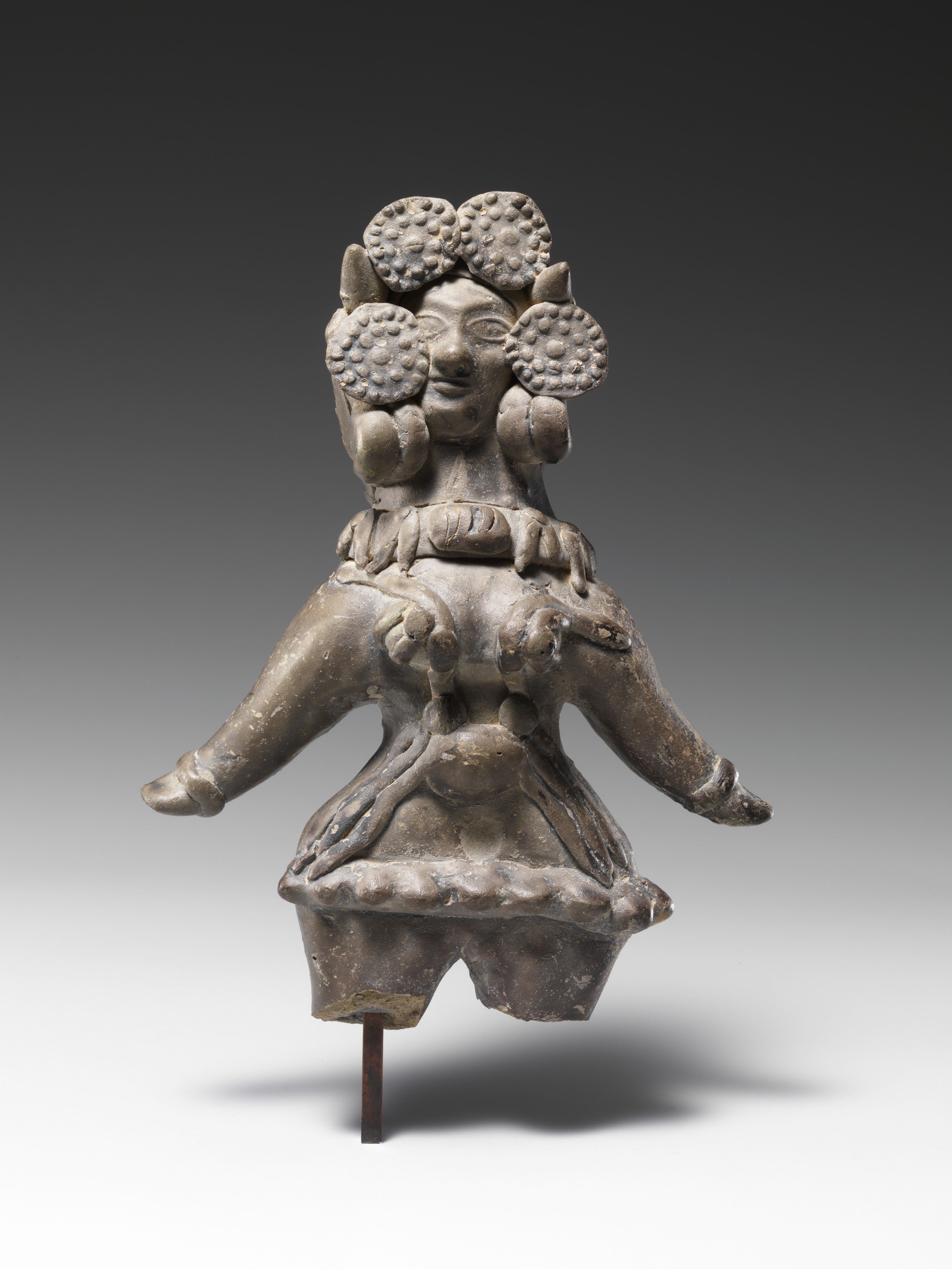
Standing Female Deity
Dublin Core
Title
Standing Female Deity
Subject
Mauryan Period
Description
"Goddesses were produced in vast quantities; used for personal devotion."
"Medium: Terracotta, black oxidation patina"
"Dimensions: H. 6 1/4 in. (15.9 cm); W. 4 3/4 in. (12.1 cm); D. 1 7/8 in. (14.8 cm)"
"Classifications: Sculpture"
The two objects that I have found is the "Standing Female Deity" and "Avalokiteshvara, the Bodhisattva of Infinite Compassion." The reason I chose these sculptures is that I wanted to show that deities are both female and male. I wanted to illustrate that they both 'look the part.' What I mean by this is that I realized that the females head covering is quite similar to that of the males. Due to the fact that they are both deities, it definitely shows their power and domination over their lands. Also, I noticed that the way their posed shows a lot of stableness and strength. For example, the woman was standing upright and her posture looked confident and secure. The man, on the other hand, looked more relaxed and still tough on the bench. The material that is used to create these sculptures also plays a role. Bronze, handmade coils, and molds were used to create these spectacular intricate sculptures.
I wish to have a better understanding of how to find credible resources that would only strengthen my descriptions and knowledge of the subject (art).
"Medium: Terracotta, black oxidation patina"
"Dimensions: H. 6 1/4 in. (15.9 cm); W. 4 3/4 in. (12.1 cm); D. 1 7/8 in. (14.8 cm)"
"Classifications: Sculpture"
The two objects that I have found is the "Standing Female Deity" and "Avalokiteshvara, the Bodhisattva of Infinite Compassion." The reason I chose these sculptures is that I wanted to show that deities are both female and male. I wanted to illustrate that they both 'look the part.' What I mean by this is that I realized that the females head covering is quite similar to that of the males. Due to the fact that they are both deities, it definitely shows their power and domination over their lands. Also, I noticed that the way their posed shows a lot of stableness and strength. For example, the woman was standing upright and her posture looked confident and secure. The man, on the other hand, looked more relaxed and still tough on the bench. The material that is used to create these sculptures also plays a role. Bronze, handmade coils, and molds were used to create these spectacular intricate sculptures.
I wish to have a better understanding of how to find credible resources that would only strengthen my descriptions and knowledge of the subject (art).
Creator
"North India"
Publisher
The Metropolitan Museum of Art
Date
"3rd–2nd century B.C."
Contributor
Yuliya Shveykina
Rights
Copyright. The Metropolitan Museum of Art.
Used here for educational purposes only.
Used here for educational purposes only.
Relation
Mauryan Period Sculptures
Format
"Medium: Terracotta, black oxidation patina"
"Dimensions: H. 6 1/4 in. (15.9 cm); W. 4 3/4 in. (12.1 cm); D. 1 7/8 in. (14.8 cm)"
File format: Jpeg
"Dimensions: H. 6 1/4 in. (15.9 cm); W. 4 3/4 in. (12.1 cm); D. 1 7/8 in. (14.8 cm)"
File format: Jpeg
Language
English
Type
Image Type
Identifier
https://www.metmuseum.org/art/collection/search/38431
Coverage
"Period: Mauryan period"
"Date: 3rd–2nd century B.C."
"Geographic Location:
Asia (70,958)
India (3,721)"
"Date: 3rd–2nd century B.C."
"Geographic Location:
Asia (70,958)
India (3,721)"
Collection
Citation
"North India", “Standing Female Deity,” World History 1 Online, Spring 2019, accessed October 17, 2026, https://jacknorton.org/1101-online-sp19/items/show/42.