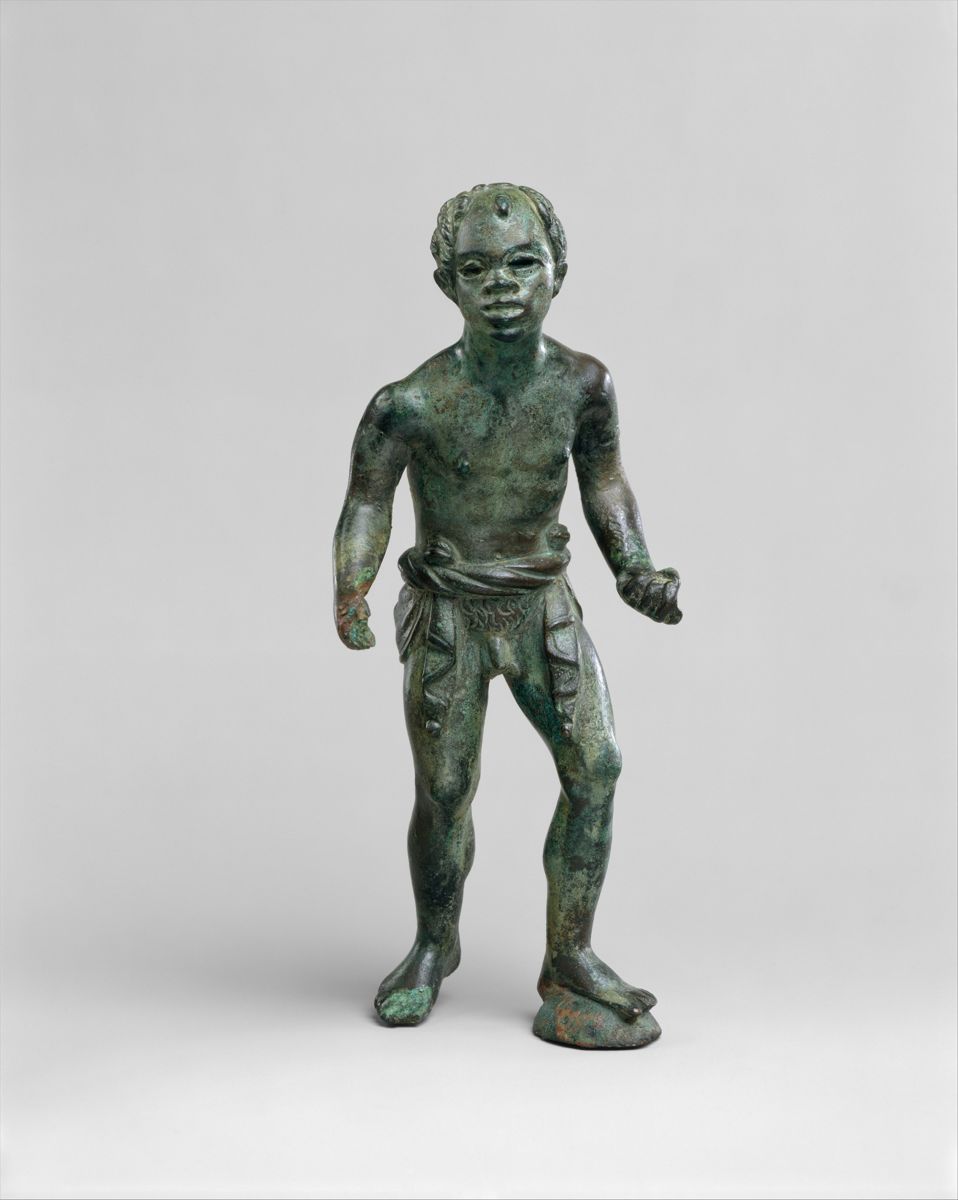
Bronze statuette of an African (known as Ethiopian) youth
Dublin Core
Title
Bronze statuette of an African (known as Ethiopian) youth
Subject
Hellenistic sculptures/bronzes
Description
"Bronze statuette of an African (known as Ethiopian) youth."
"Medium: Bronze
Dimensions H. 18.29 cm.
Classification: Bronzes" From the museum website description
The two objects that I chose tell us about the everyday lives of two different classes to the extent that we still see these differences today. The Terracotta draped women tells us that this woman had access to elite clothing, as my research has come to the conclusion that himation was elite in the Hellenistic time period. On the other hand, the Bronze statuette of an African (known as Ethiopian) youth suggests that this boy worked many hours in the sun because of scars that are present throughout his body. In addition, this boy does not have much clothing on which suggests that he was not in the elite class. These two objects suggest that there was a stark difference between the lifestyles of these individuals. It seems that the elite class did not even care about the lower class and that the elites profited from the lower class’s hard work. I believe that this is similar to all periods in the past since individuals who have dark color on their skin are considered of a lower class which is present through these two objects. Therefore, if unfair classes were present in the past, why are these differences still present today? Although it is not as severe in today’s world, however, it is still present. My learning objective is that I would like to be able to express my thoughts in as few words as possible.
"Medium: Bronze
Dimensions H. 18.29 cm.
Classification: Bronzes" From the museum website description
The two objects that I chose tell us about the everyday lives of two different classes to the extent that we still see these differences today. The Terracotta draped women tells us that this woman had access to elite clothing, as my research has come to the conclusion that himation was elite in the Hellenistic time period. On the other hand, the Bronze statuette of an African (known as Ethiopian) youth suggests that this boy worked many hours in the sun because of scars that are present throughout his body. In addition, this boy does not have much clothing on which suggests that he was not in the elite class. These two objects suggest that there was a stark difference between the lifestyles of these individuals. It seems that the elite class did not even care about the lower class and that the elites profited from the lower class’s hard work. I believe that this is similar to all periods in the past since individuals who have dark color on their skin are considered of a lower class which is present through these two objects. Therefore, if unfair classes were present in the past, why are these differences still present today? Although it is not as severe in today’s world, however, it is still present. My learning objective is that I would like to be able to express my thoughts in as few words as possible.
Creator
"Greek"
Publisher
The Metropolitan Museum of Art
Date
"3rd–2nd century B.C."
Contributor
Inara Hirani
Rights
Copyright. The Metropolitan Museum of Art.
Used here for educational purposes only.
Used here for educational purposes only.
Relation
Bronze sculptures
Format
"Medium: Bronze
Dimensions: H. 18.29 cm. as mentioned by the resource's website
File format: Jpeg
Dimensions: H. 18.29 cm. as mentioned by the resource's website
File format: Jpeg
Language
English
Type
Image Type
Identifier
https://www.metmuseum.org/art/collection/search/250673
Coverage
"Period: Hellenistic
Date: 3rd–2nd century B.C.
Geographic Location
Europe (185,178)
Greece (22,187)"
Date: 3rd–2nd century B.C.
Geographic Location
Europe (185,178)
Greece (22,187)"
Collection
Citation
"Greek", “Bronze statuette of an African (known as Ethiopian) youth,” World History 1 Online, Spring 2019, accessed October 17, 2026, https://jacknorton.org/1101-online-sp19/items/show/32.